
By Grace Anne Dela Cruz
Transportation is one of the many factors to consider when deciding where to reside long-term, with public transportation often being an important consideration. While public transportation on Guam has its strengths and limitations, it plays a critical role in the context of Guam’s healthcare landscape, particularly regarding access to primary care and preventative services. Transportation for these services is often referred to as non-emergency medical transportation (NEMT) and is necessary for many who seek healthcare visits. Transportation accessibility, affordability, and reliability can pose a physical barrier to healthcare, increasing the risk for poor health maintenance and the development of chronic health conditions, many of which are prevalent on Guam. Though transportation is only one factor in healthcare accessibility, it can be the first step in addressing longstanding systemic barriers between Guam residents and optimal health.
About the Author
Grace Anne Dela Cruz is a rising senior at the University of Guam, where she is pursuing a Bachelor of Science in Nursing degree with a minor in Public Administration. As Guam’s 2025 Truman Scholar, Grace Anne spent her summer interning at the Weitzman Institute’s DC office through the Truman Foundation’s Summer Institute Program. Grace Anne returns to Guam eager to continue her studies and apply insights gained during her time at Weitzman.
Transportation in the Context of Health
Reliable transportation ensures that any individual can access medical appointments on time and receive necessary health services. A lack of reliable and affordable transportation can work even against those who strive to maintain positive health-promoting behaviors. In line with Guam’s higher cost of living and poverty rates more than double that of the U.S. as a whole, many families must choose between necessities such as food, water, and shelter – or healthcare. Delayed care can lead to hospitalizations for preventable conditions like complicated wounds or infections. Though transportation is not the only influence on the community’s access to healthcare, it often determines whether someone sees a primary care provider regularly.
Primary care access is especially important on Guam, as the majority of Guam’s population is predisposed to chronic diseases like diabetes, hypertension, and cardiovascular disease. CHamorus, the indigenous people of Guam, experience hypertension, obesity, and diabetes at similar or higher rates than the island’s other populations, increasing their risk of coronary heart disease, heart attacks, and stroke. Other ethnic groups on the island, including Filipinos and other Pacific Islander communities, are also predisposed to these conditions, illustrating the importance of regular access to primary care. These predispositions are exacerbated by lack of physical activity, poor diet and behaviors like smoking. Inaccessible transportation is a barrier to health management for individuals affected by these conditions, especially those with limited mobility, which can increase healthcare needs and long-term costs.
Transportation on Guam
While personal vehicles are the preferred mode of transportation on Guam, the Guam Regional Transit Authority (GRTA) manages a robust public transportation system. GRTA is funded by a mix of local appropriations, federal grants, and generated revenue through fares and primarily offers bus services with fixed lines running throughout several regions of the island. GRTA also provides paratransit or demand-response services for eligible residents who are unable to use traditional public transportation routes. Private, more costly options include van services, taxis, ride-hailing apps like Stroll Guam, and car rentals. All modes are affected by heavy vehicle traffic in the early mornings and late afternoons as people head to school and work.
Utilization of Public Transportation
Despite several options, transportation barriers to healthcare persist across three main themes: (1) accessibility, (2) affordability, and (3) reliability.
Accessibility
Accessibility speaks to how safely and efficiently residents can get to and from a designated bus stop or terminal. Despite Guam’s size, most areas outside popular tourist destinations are not pedestrian-friendly. Residential and urban centers are often separate, leaving a disconnect that reduces access to established public transportation routes. In addition, roads and associated infrastructure, such as sidewalks and pedestrian crosswalks, are often not well maintained or non-existent. This disconnect can be especially challenging for individuals with limited mobility and/or disabilities. Paratransit services are offered for those who cannot use fixed transit routes, but these accommodations are only guaranteed for same-day service if the resident can be picked up within a 3/4 mile radius of any designated bus stop. Outside this radius, rides must be scheduled at least 24 hours in advance, making it difficult to access same-day, acute care.
Figure 1 depicts fixed bus lines operated by GRTA. Most serve northern-central Guam’s well-developed urban centers. Beyond these areas, bus stops are more widely spaced, leaving residents underserved or unserved altogether. Only two federally-supported community health centers serve Guam’s residents, providing care for patients regardless of their ability to pay: Northern Regional Community Health Center in Dededo and Southern Regional Community Health Center in Inarajan (see Figure 1). Residents living in central Guam who seek care at these health centers must travel long distances, making accessibility difficult. Outreach and mobile clinics partially fill these gaps but are not long-term solutions for healthcare access and equity.
Figure 1
Guam Regional Transit Authority Fixed Route Bus Lines
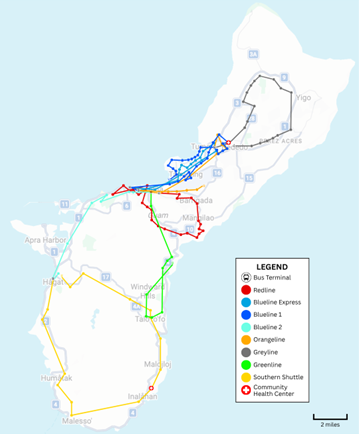
Note: Map created by author using Guam Regional Transit Authority data and Canva
Affordability
Table 1 lists the average costs and fees associated with established transportation services, excluding tourist-specific buses and transportation for specific services like cancer care. Though these costs may seem low relative to transportation in the continental U.S., household income on Guam varies widely with approximately 1 in 5 individuals living in poverty. In addition, factors such as frequent appointments, larger family sizes, and high cost of living can make healthcare transportation unaffordable.
While Medicaid is widely used on the island, with about 20% of the population enrolled, transportation barriers persist. Medicaid programs are mandated to include NEMT services for enrollees to and from medical offices and appointments, yet many families may not be aware of this benefit. Moreover, this benefit is not available to many families who do not qualify for Medicaid but cannot afford other services.
Table 1
Cost Comparison of Local Transportation Modes, Public and Private
| Public - GRTA | Private - Accessible Van Transportation Services | Private - Access Medical Transport |
||||
|---|---|---|---|---|---|---|
| Fare/ Pass Type |
Adults 19-54 |
Children / Adults 55+ / Paratransit |
SUV | Wheelchair Van | ||
| Per Trip | $1.50 | $0.50 | Per Trip (8 AM - 5 PM) |
$50 | $20/trip (Central) $35/trip (Northern/ Southern) |
One Way $75 |
| 1-Day | $4.00 | $1.50 | Before/After Hours |
+$10 | Round Trip $150 | |
| 1-Week | $20.00 | $7.50 | Wheelchair Use Fee |
+$10 | Standby (15 mins.) $25 | |
| 1-Month | $65.00 | $25.00 | Wait Time (15-30 mins.) |
+$15 | Standby (1 hour) $100 | |
| Private - Taxi | Private - Stroll Guam (Ride-hailing Service) |
Private - Rental Car | ||||
| Flag Rate | $2.40 | Base Fare | $1.05 |
$34-$74/day (can increase based on car model and reservation time) |
||
| 1st Mile | $4.00 | Minimum Fare | $4.15 | |||
| Additional ¼ mile | $0.80 | Per Mile | $1.30 | |||
| Per Minute | $0.55 | |||||
To address affordability concerns, Public Law 37-133 was signed by Governor Lourdes Leon Guerrero in 2024, mandating GRTA provide free bus passes for appointments or obligations with several public agencies, including Judiciary of Guam, Child Protective Services, Guam Housing and Urban Renewal Authority, Guam Behavioral Health and Wellness Center, and Guam Department of Public Health and Social Services. However, implementation has been challenging as the statute did not allocate any additional funding to GRTA to meet increased demand.
Reliability
Beyond paratransit and other specialized services, GRTA’s bus services are the only mode of fixed route public transportation on Guam. GRTA’s current schedule shows that residents can commonly expect up to one-hour wait times between runs. Some lines have even wider gaps between services, meaning that planning ahead is the only way to arrive on time to an appointment or walk-in healthcare service. Delays due to heavy traffic increase wait times drastically. Additionally, bus repair or routine maintenance can affect GRTA reliability. Due to Guam’s geographically isolated nature, vehicle parts can take weeks or months to arrive in addition to lengthy procurement processes. When parts do arrive, specialized labor may be scarce, further delaying a vehicle’s return to full service and exacerbating delays and wait times. These issues contribute to GRTA’s coverage limitations and often result in unserviced lines. When reliability suffers, residents may distrust GRTA services, especially for NEMT, leading to lower ridership and ultimately, lower revenue for the agency.
Looking Ahead
Improving Guam’s public transportation would increase healthcare accessibility, and doing so requires a three-part approach: (1) expansion and maintenance, (2) access enhancement, and (3) promotion and incentivization.
Expansion and Maintenance
GRTA plans to increase their vehicle fleet to expand serviced areas and increase the frequency of service to boost reliability and accessibility. Construction has also begun on GRTA’s new park-and-ride facility, set to be completed in 2027. Situated in Guam’s most populated village, Dededo, this new facility aims to reduce traffic congestion and connect northern and central urban hubs. Though these efforts are meant to push Guam’s public transportation system in a positive direction, these strategies depend on strategic planning, maintenance availability, and funding.
Access Enhancement
In addition to maintenance improvements, several other enhancements would increase transportation accessibility.
- Post Service Maps. Posting a map of all bus lines at designated stops and frequently visited public spaces would both promote the services and support navigation as residents move throughout the island.
- Dedicate Vehicles to Paratransit Services. Dedicating a portion of GRTA’s increased vehicle fleet specifically to paratransit services would allow for same-day service beyond the cited 3/4-mile radius from a given bus line. It would also take the load off fixed route vehicles and increase their on-time service.
- Establish Bus Stops in Unserved Residential Areas. New bus stop placements can be determined through community input and the feasibility of the proposed route.
- Invest in Live Tracking Technology. Live tracking of vehicles and expected arrival times allows residents to better plan their commute, especially for time-sensitive appointments and consultations.
- Offer Contactless Payment. Investing in the necessary technology to support contactless payment would promote efficient onboarding and alighting of passengers. Common contactless payment methods include debit/credit cards, specified transit cards, or digital wallet services like Apple Wallet/Apple Pay.
- Improve Pedestrian Infrastructure. Building new or maintaining existing sidewalks, streetlights, stoplights, and crosswalks would ensure safer passage to and from transportation access points for residents and visitors.
- Negotiate NEMT Coverage in Commercial Insurance. Including NEMT services in Guam’s commercial insurance plans would enable those not receiving Medicaid to access NEMT services, improving affordability for both public and private transportation options.
Promotion and Incentivization
To engage residents and raise awareness about offered services, increased promotion and incentivization of programs could boost ridership.
- Expand Social Media Presence. GRTA regularly updates a Facebook account, which mostly serves the island’s older population. Establishing a presence on other platforms such as Instagram would engage youth and potentially increase ridership among younger individuals.
- Create Incentive Programs. Because most individuals and families already own a personal vehicle, increasing public transportation usage can be a challenge. Creating an incentive or “points” program could entice residents to utilize services in order to avail of certain prizes, discounts, or free services.
- Raise Awareness about Environmental Impact. Reducing the use of personal vehicles and supporting more efficient public options would reduce local air pollution. Sharing data on traffic congestion and its environmental effects can evoke an emotional responsibility to reduce one’s carbon footprint.